Woodward Integrated Load Management System For VPPL
Asian Power Controls supplied and commissioned a Woodward Integrated Load Management System to coordinate three steam turbine generators, two grid incomers and two bus couplers. The solution improved synchronization, load management and import/export control while preventing nuisance turbine tripping after grid failure.
Customer Profile
- Industry
- Sugar and Co-generation
- Application
- Integrated load management
Venkateshwara Power Project Ltd. (VPPL) operates a sugar and co-generation plant in Karnataka. The factory has been operational since 2001, and its co-generation unit has been in operation since 2004.
To improve power generation reliability and distribution control, VPPL required an advanced load management solution for its multi-turbine, multi-grid power system.
Existing System
The plant initially operated two steam turbine generators rated 8 MW and 15 MW, synchronized with Grid-1 for power export.
The plant was subsequently expanded with an additional 25 MW steam turbine generator and a Grid-2 incomer, along with bus-coupler synchronization and power export capability through both grids.
The resulting arrangement involved three steam turbine generators, two grid incomers and two bus couplers. This increased system complexity and required integrated load management and synchronization control.
Problem
Before implementation of the new system, VPPL faced several operational problems:
- High synchronization time.
- Improper load sharing after grid failure.
- Frequent turbine tripping after grid failure or voltage fluctuations.
- Low sensitivity of grid protection.
- Export power variation.
The existing arrangement was insufficient for stable operation in the expanded multi-turbine, multi-grid configuration.
Customer Impact
Turbine trips following grid failure disrupted the complete crushing cycle and affected production continuity.
- Sugar production loss.
- Power generation loss.
- Risk of equipment failure.
- Reduced operational reliability of the plant.
These impacts made stable synchronization and coordinated load management critical to plant operation.
Solution Provided by Asian Power Controls
Asian Power Controls Pvt. Ltd. supplied and commissioned a Woodward Integrated Load Management System (ILMS) in 2024 to address the plant's synchronization and power management challenges.
- Synchronization of all three steam turbine generators.
- Coordination of two grid incomers.
- Control of two bus couplers.
- Integrated load management according to the plant single-line diagram.
The solution brought the turbine generators, grid incomers and bus couplers into a coordinated control arrangement for the expanded power system.
System Supplied
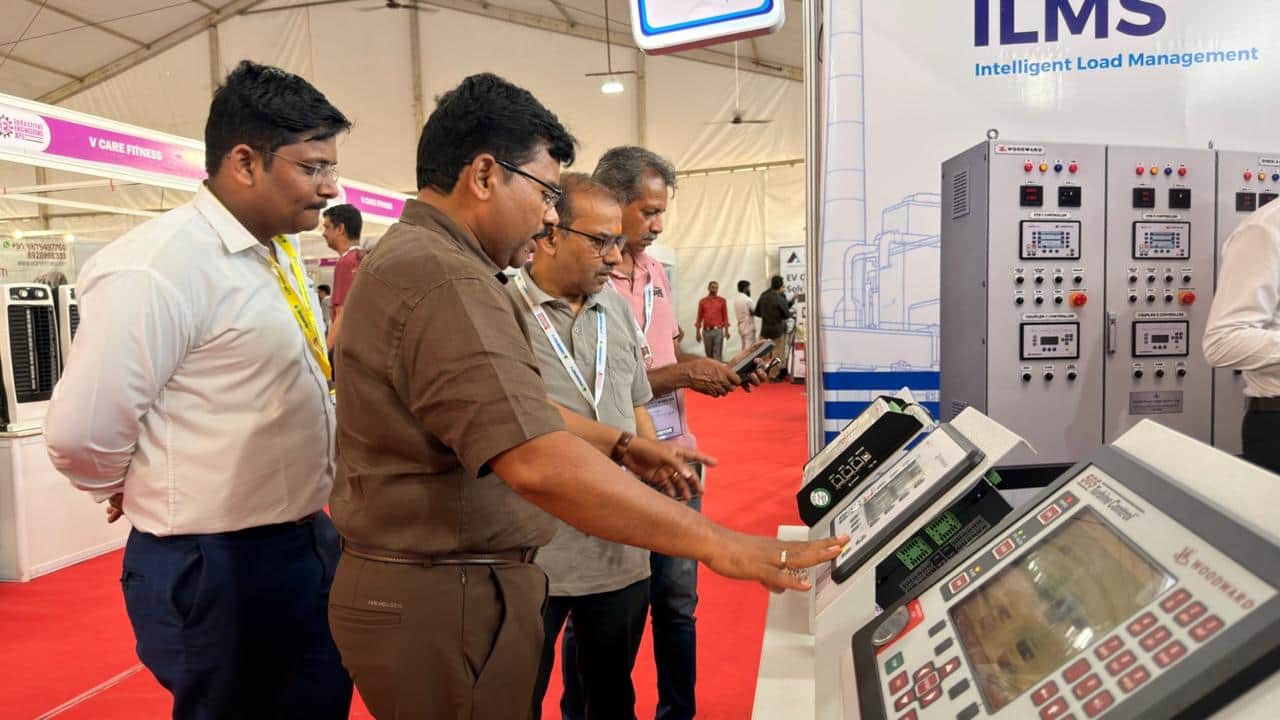
Woodward Integrated Load Management System (ILMS) Panel
Turbine Load Controller
Grid Breaker Controller
Bus-Coupler Controller
Woodward easYgen Series
turbine breaker monitoring, proportional load sharing, load control, import/export control and VAR control.
Woodward LS Series mains controller
grid breaker control, bus-coupler control and monitoring, breaker loading/unloading functions, and CAN communication with easYgen controllers.
Synchronization breakers and SLD-based integrated control architecture.
The plant single-line diagram shows the arrangement of the 8 MW, 15 MW and 25 MW turbine generators, both grid incomers, BUS-1 and BUS-2 controllers, and the controller communication network.
Benefits Achieved
Following successful commissioning of the Woodward ILMS, the case study reports the following benefits:
- Improved plant reliability.
- Prevention of nuisance turbine tripping after grid failure.
- Efficient load management across the three steam turbine generators and two grids.
- Improved synchronization performance.
- Improved import/export control.
- Improved plant power factor.
- Increased power generation.
- Increased power export.
- Stable operation of the co-generation power system.
The solution improved operational stability and overall power management performance at VPPL.